
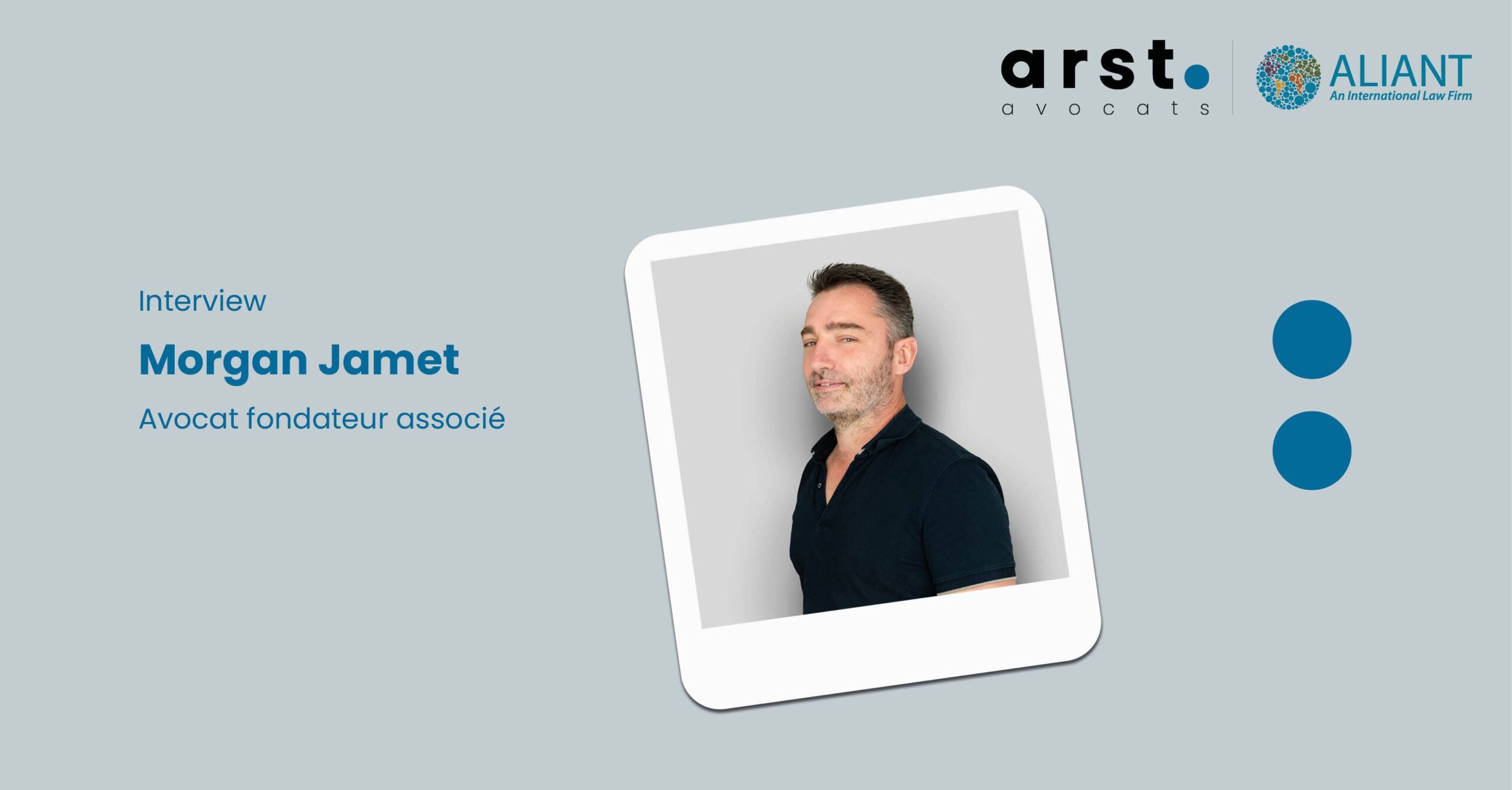
Morgan Jamet presents the Contracts practice of the law firm ARST Avocats
ARST Avocats assists companies, their executives, and their legal departments in drafting, negotiating, auditing, and litigating their commercial contracts. Morgan Jamet, the firm's founding partner, presents a practice that combines contract law, an understanding of business operations, and litigation experience to secure every stage of the business relationship.
Morgan Jamet, what is your background and what role does contract law play in your practice?
I have practiced as a business lawyer since 1999. I founded ARST Avocats with the ambition of building a firm capable of supporting companies over the long term, both in advisory and litigation matters. This dual approach has always structured my practice.
Contract law naturally constitutes one of its central axes. A contract is not simply a text to be drafted before signing: it organizes an economic relationship, distributes responsibilities, anticipates difficulties, and must remain usable by those who execute it.
I am involved in the design and negotiation of contracts, but also when it is necessary to interpret them, renegotiate them, organize their transfer or termination, or defend the interests of a client when a dispute arises.
This cross-functional practice leads me to work with the firm's other expertise, particularly in corporate law, intellectual property, digital and data law, companies in difficulty, commercial leases and business litigation.
How would you define ARST Avocats' Contracts practice today?
Our team supports companies, groups, executives, investors and legal departments throughout the entire contractual cycle: pre-contractual negotiations, drafting, review, negotiation, signing, execution, renewal, audit, renegotiation and exit from the relationship.
We work on a wide variety of commercial contracts: sales, supply, service, subcontracting, manufacturing, maintenance, partnership, business referral, mandate, commercial agent, transport and logistics, licensing, as well as IT, digital or SaaS contracts.
We also draft and negotiate documents that frame the pre-contractual period, such as confidentiality agreements, letters of intent, negotiation protocols, exclusivity agreements or documents organizing a testing phase.
Our role varies according to the client's needs: securing a specific contract, building complete contractual documentation, assisting in sensitive negotiations, harmonizing a company's models, or taking charge of analyzing a large portfolio of contracts.
What types of projects do you work on?
Some requests arise from a specific operation: launching a new offer, choosing a partner, developing a network, acquiring a business, changing service providers, internationalization or deploying a digital tool.
Others address a difficulty that arose during the execution of the contract: delay, non-compliance, cost changes, disagreement on the scope of services, non-payment, supply difficulties, failure of a co-contractor or planned termination of the relationship.
We are also asked to adapt contracts to regulatory or operational changes. The widespread adoption of electronic invoicing is a good example: it requires companies to revise certain clauses relating to the issuing, receiving, checking, rejecting and paying invoices, as well as their internal procedures and the distribution of responsibilities between different departments.
Our cases cover a wide range of sectors, including franchising and restaurants, distribution, commercial real estate, air transport, energy, construction, services, and digital activities. This diversity requires us to quickly understand the business model, practices, and specific constraints of each sector.
What is your approach to drafting and negotiating contracts?
We begin by understanding the project before writing. The initial meetings serve to identify the economic objective, the stakeholders involved, the flows, the dependencies, the timeline, the possible breaking points, and the balance of power in the negotiation.
We then aim to produce a legally sound document, but above all, a usable one. The obligations must be understandable, the responsibilities consistent with the realities of the project, and the planned mechanisms effectively applicable.
A clause that appears very protective can become useless if the teams cannot implement it or if it does not correspond to the actual functioning of the company.
We therefore pay particular attention to:
- to the purpose and scope of the services;
- to prices and their revision terms;
- orders, volumes and deadlines;
- to service levels and performance indicators;
- to delivery, receipt or acceptance procedures;
- to guarantees and penalties;
- to liability and insurance;
- to intellectual property and data;
- to compliance obligations;
- to the duration, renewal and exit conditions.
When appropriate, we work directly with the client's legal, commercial, financial, technical, or IT teams. The contract must be consistent with their way of working and with the commitments they are actually able to fulfill.
Does the firm retain any particular expertise in mass contractual audits?
Yes. ARST Avocats has acquired real experience in the coordinated review of large volumes of contracts.
This expertise now belongs to the firm and is based on a proven method: prior definition of analysis criteria, creation of a common grid, classification of risks, cross-checking, consolidation of results and directly usable reporting.
These contractual audits can be conducted on occasion:
- of an acquisition or a sale;
- of a restructuring;
- of compliance;
- of a reorganization of purchasing or sales;
- of a change in information system;
- of a project to standardize contractual documentation;
- of the takeover or reorganization of a network.
In particular, they allow for the identification of deadlines, tacit renewals, change of control clauses, exclusivity agreements, volume commitments, guarantees, limitations of liability, termination conditions, transfer restrictions and authorizations to be obtained.
The goal is not to accumulate reading notes. It is to prioritize the risks, highlight the decisions to be made and, if necessary, prepare a renegotiation or regularization plan.
Depending on the volume of contracts, their complexity and the timing of the operation, we assemble a dedicated team and implement a consistent management method.
What role do distribution and franchising play in this activity?
They occupy an important place. We advise suppliers, manufacturers, distributors, franchisors, franchisees and network heads in the choice and implementation of their distribution model.
Our intervention can cover a franchise, a brand license, exclusive or selective distribution, a commercial concession, a commission-affiliation, a commercial agency, referencing or a development partnership.
In franchising, we can support a project from the analysis of its franchiseability to the drafting of the pre-contractual information document, the franchise agreement and the contracts necessary for the operation of the network.
We also handle changes to the concept, contract renewals, sales outlet transfers, network entries and exits, as well as disputes between franchisors and franchisees.
The firm has particular experience in structuring and documenting networks comprising over one hundred establishments. This experience allows us to anticipate not only legal requirements, but also the operational challenges associated with developing and managing a network.
How do you combine advisory services and contractual litigation?
This is one of the strengths of our practice. Litigation experience improves contract drafting because it allows us to gauge how a clause will be understood, proven, and challenged if the relationship deteriorates.
Conversely, mastering the economics of the contract and its history allows for the construction of a more relevant pre-litigation or judicial strategy.
We therefore intervene when the execution of the contract becomes difficult: formal notice, exception of non-performance, application or contestation of penalties, request for compensation, renegotiation of price or schedule, force majeure, unforeseen circumstances, termination, cancellation, breakdown of an established business relationship or organization of a negotiated exit.
Our primary objective remains, whenever possible and in the client's best interests, to seek a mutually agreeable solution. This may involve an amendment, a settlement agreement, a regularization schedule, or a negotiated termination of the relationship.
When litigation cannot be avoided, the case is handled in close collaboration with the Business Litigation team, before the competent courts or through arbitration.
How is the team organized around a case?
We assemble the team based on the project, its urgency, and the skills required. Most often, a pair or a trio is sufficient.
The client retains a limited number of contacts, while we can occasionally mobilize other skills within the firm when the contract raises an issue of social law, intellectual property, data, corporate law, insolvency proceedings or real estate.
This organization allows us to maintain a direct and responsive relationship while ensuring the necessary cross-validation on sensitive topics.
We can also intervene in support of a legal department to absorb a peak in activity, carry out a specific project, conduct an audit campaign, build contract templates or train teams in their use.
What characterizes the way ARST Avocats works?
Pragmatism first. We never lose sight of the fact that the contract must serve a project and be usable on a daily basis.
Responsiveness is also important, as contract negotiations often take place within a tight commercial timeframe.
Finally, accessibility. We explain the risks and available options so that the client can make an informed decision. Our role is not simply to point out that a clause presents a risk, but to assess its consequences, propose solutions, and identify the key areas for negotiation.
Our goal is not to eliminate all risk, which would be unrealistic, but to identify it, distribute it, and make it manageable. A good contract protects the company without preventing the transaction from taking place.
In what situations should a company consult a contract lawyer?
As early as possible when the contract involves a significant commitment, a long-term relationship, a substantial investment, know-how, a brand, data, exclusivity, or a situation of economic dependence.
Early intervention often helps to prevent an insufficiently defined commercial agreement from subsequently turning into a legal difficulty.
It is also useful to have contracts and general terms and conditions audited periodically, especially when the business evolves, a new sales channel is created, regulations change, or the models used no longer correspond to internal practices.
Finally, it is best to seek help quickly at the first signs of tension. The correspondence exchanged, the reservations expressed, and the decisions made at this stage can determine the course of the case and the available evidence.
What are your ambitions for this practice?
We want to continue to develop a benchmark practice in contract and distribution law, recognized both for its technical expertise and its operational utility.
This requires remaining attentive to business transformations: digitization of relationships, data management, SaaS tools, automation, new compliance obligations, electronic invoicing and evolving distribution models.
Our ambition remains simple: to be the team that our clients call upon to build a contractual relationship, to develop it, secure it, or, when necessary, to organize its exit and defend their interests.
Need support with contract law?
ARST Avocats assists companies in drafting and negotiating their commercial contracts, conducting contractual audits, organizing their distribution and franchise networks, and handling their contractual disputes.
Discover our expertise in contract, distribution and franchise law or contact our team directly to discuss your project.
Should a lawyer draft a formal notice?
A formal notice can trigger the accrual of interest, pave the way for the termination of a contract, or constitute a decisive piece of evidence in court. When should it be entrusted to a lawyer?
Family SCI or joint ownership: which structure to choose for a family property purchase?
By Olivier Paquerau, of counsel at ARST Avocats. Buying a home, a rental property, or a family residence with several people quickly leads to a fundamental question: should you buy jointly or form a real estate company?...
Psychosocial risks in the workplace: what are the employer's obligations?
By Chaouki Gaddada, partner lawyer in charge of employment law at ARST Avocats. Chronic stress, work overload, isolation, internal conflicts, loss of meaning, or reports of harassment: psychosocial risks can weaken employees...
Should a lawyer draft a formal notice?
A formal notice can trigger the accrual of interest, pave the way for the termination of a contract, or constitute a decisive piece of evidence in court. When should it be entrusted to a lawyer?
Family SCI or joint ownership: which structure to choose for a family property purchase?
By Olivier Paquerau, of counsel at ARST Avocats. Buying a home, a rental property, or a family residence with several people quickly leads to a fundamental question: should you buy jointly or form a real estate company?...
Acquiring 10% of a French company listed in London can now trigger an audit by the French Ministry of Economy and Finance (Bercy)
Since August 17, 2026, crossing the 10% threshold of voting rights of a French company listed on certain foreign markets may fall under the control of foreign investments in France.