
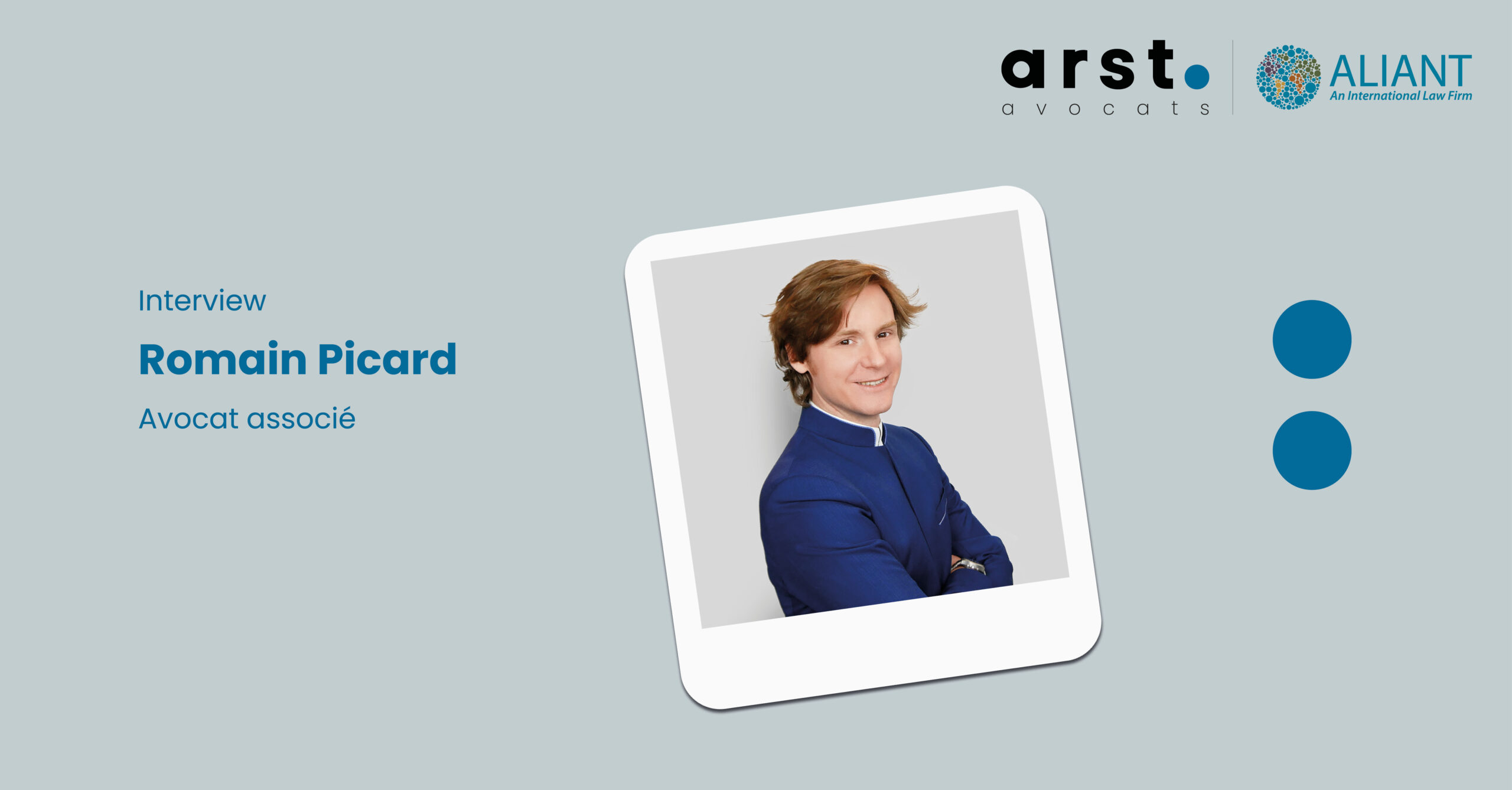
Romain Picard, can you remind us of your career path?
I was fortunate—some might call it unfortunate—to begin my career in large French and international firms. For me, it was a stroke of luck because I was able to practice the field I wanted: Corporate /M&A, at the highest level. While this certainly has its drawbacks, it allows you to handle cases that are difficult to access otherwise, cases whose main characteristic isn't the number of zeros in the financial stakes, but rather their international scope and tight deadlines. I absorbed the professionalism of these firms, their responsiveness, and the exceptional quality of service they are expected to provide to clients. After a few years, with my personal client base growing rapidly, I wanted to become a partner myself. And it was with this status that I joined the firm Arst Avocats.
Isn't this a curious choice? Arst Avocats is hardly a large law firm, let alone an Anglo-Saxon one?
Oh dear, so I was wrong? (laughs). I know, and it was a conscious choice to join such a firm. I had a choice (three options, to be precise) regarding the type of firm I could become a partner in. If I ruled out the other two options, which were significantly larger firms, it's because I wanted to take a chance on my own development in a young firm, where everything is still possible, where partners can be bold and practice as they wish without excessive constraints. I was looking for a supportive environment, freedom, and flexibility. At Arst Avocats, I can develop areas of expertise and clients that would have been much more difficult to cultivate in a large firm. The hourly rates I can offer my clients for highly technical and high-quality services are also a significant advantage for my professional growth. It was also essential for me that the firm offer full-service business law (Corporate/M&A, commercial law – leases, litigation , restructuring – insolvency proceedings , employment law , tax law ) in order to strengthen the bond of trust with my clients: remaining their trusted point of contact on a daily basis while also giving them the opportunity to rely on my partners for a broader range of expertise. Finally, as I am very committed to teamwork in law firms, I wanted the firm where I joined to develop my career to share my own values. Having had the opportunity to work with Morgan Jamet and the Arst Avocats teams on several occasions in recent years allowed me to quickly envision myself in this role. It's a gamble, both for me and for Arst Avocats, who have also placed their trust in me.
What are your specific areas of expertise?
I have the ability to handle mergers and acquisitions, private equity, and restructuring transactions of all sizes and in complex environments, particularly multinational or regulatory ones, coordinating internal and external teams as needed. And since I can handle the larger tasks, I can also handle smaller ones, which gives me a wide range of opportunities. Of course, I've also maintained some more specialized skills, such as foreign investment control in France. This already provides a broad scope of activity, especially since clients often want us to continue addressing other issues by coordinating the various stakeholders.
What specific activities do you wish to develop within this structure?
"Develop" seems to me the right word. Arst Avocats already has a Corporate/M&A practice. My aim, by building on the existing teams with whom I already enjoy working, is to broaden our scope in terms of the types and sizes of transactions, as well as our international reach. Arst Avocats had already begun the initial steps of internationalizing its practice . I hope to contribute, alongside Jefferson Larue , another partner at the firm, to building on this foundation. We have already started to achieve some small successes. I hope to help demonstrate that mid-sized firms like Arst Avocats can effectively provide clients who might otherwise have naturally gravitated towards the largest firms with equally high-quality services, but with an added personal touch and competitive financial terms.
What were the reactions of your professional circle following this partnership?
They were, of course, very positive. I received many congratulations. But that's not the most important thing. I felt that some of my clients had been waiting for this kind of development. They showed me this by immediately entrusting me with new matters that they perhaps didn't think they could discuss with me before. Becoming a partner in a firm demonstrates to clients that other lawyers have recognized your ability to belong not to a select group, but to a level of professional competence, not just technical expertise. Being a partner is, above all, about being responsible: for your clients, your colleagues, and for what you do. It's up to me to prove myself worthy of that responsibility in the eyes of my partners and my clients.
How do you see the year 2023?
It's off to a good start and there's no reason why it shouldn't continue this way. The ongoing operations allow me to create momentum with the teams at Arst Avocats, and we have some exciting projects in the pipeline.

Max Mietkiewicz
Communication Manager
Repetition of old-age benefits obtained by fraud
Court of Cassation, Plenary Assembly, May 17...
Biennial prescription: the Court of Cassation finally sets limits in favor of insurers
The obligation to inform insurers about the causes of interruption of the two-year prescription does not require mentioning the entire article 2243 of the Civil Code according to which the interruption does not take place when the claimant give up, leave...
Confidentiality of meetings between parties and lawyers: rules to know
Reminder of the rules governing the confidentiality of meetings held in the presence of the parties and their lawyers. Pursuant to Article 3 of the National Internal Regulations of the Legal Profession (“RIN”), professional secrecy covers correspondence exchanged...
Repetition of old-age benefits obtained by fraud
Court of Cassation, Plenary Assembly, May 17...
Biennial prescription: the Court of Cassation finally sets limits in favor of insurers
The obligation to inform insurers about the causes of interruption of the two-year prescription does not require mentioning the entire article 2243 of the Civil Code according to which the interruption does not take place when the claimant give up, leave...
Confidentiality of meetings between parties and lawyers: rules to know
Reminder of the rules governing the confidentiality of meetings held in the presence of the parties and their lawyers. Pursuant to Article 3 of the National Internal Regulations of the Legal Profession (“RIN”), professional secrecy covers correspondence exchanged...