
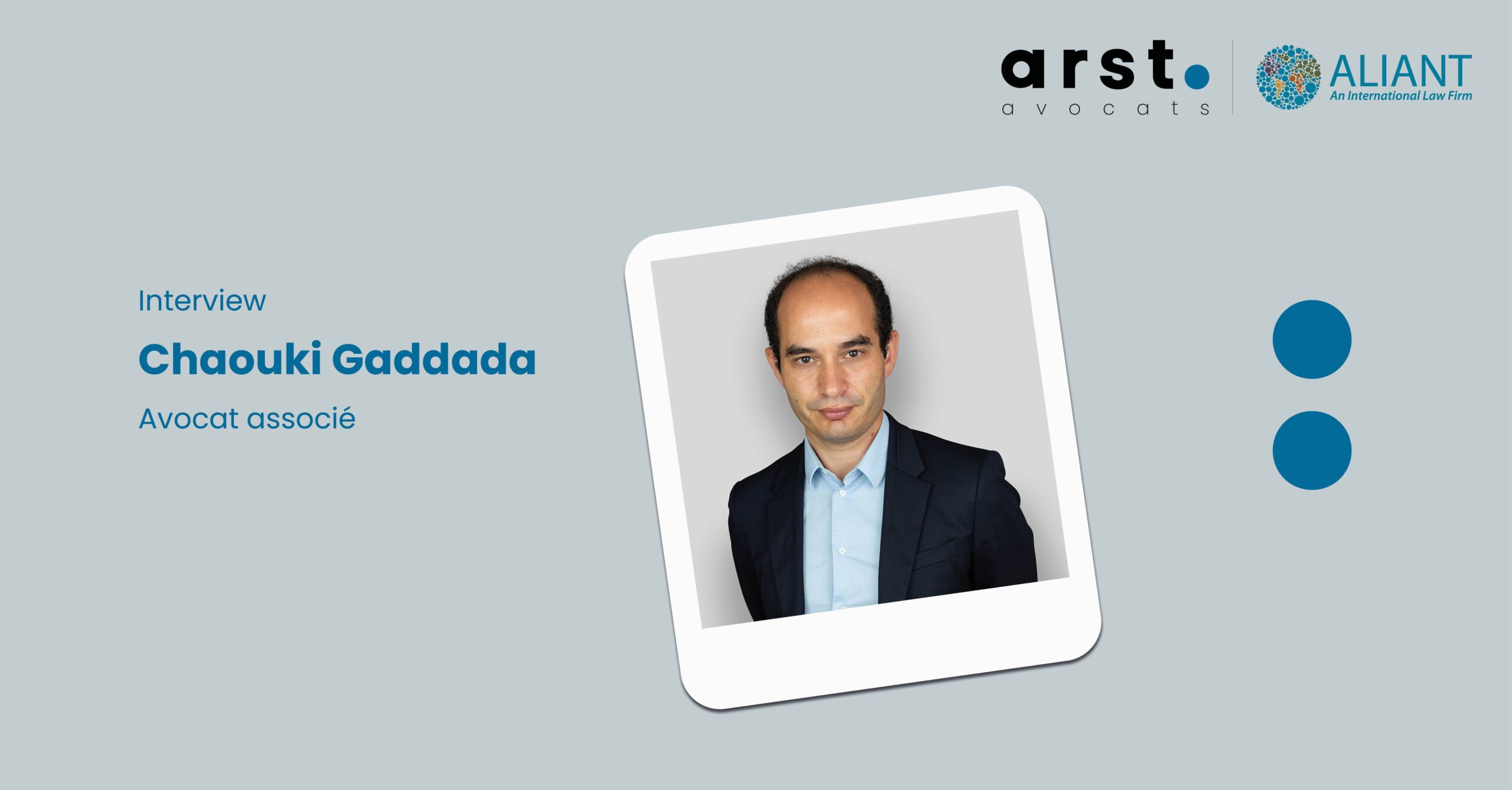
Chaouki Gaddada, can you tell us about your background?
Yes, of course. I was sworn in in October 2011 and I initially worked in firms primarily dedicated to supporting employer clients, which allowed me to discover the profession and strengthen my skills.
I joined the firm Arst Avocats in May 2014, where I became a partner in January 2018. Now comprising seven partners, we are a so-called full-service business law firm, organized around areas of activity, including contract law, commercial law, corporate law and social law.
Specifically, what can you tell us about the Social Law – Social Security department of the Arst Avocats firm?
The team currently consists, in addition to myself, of two colleagues. We can also rely on the occasional support of Morgan Jamet on certain matters, particularly in negotiating departures, where he has considerable expertise.
We provide both advisory and litigation services to employers and employees.
We are deeply committed to this dual practice, which allows us to handle a wide variety of situations, with employment litigation at the heart of our work. We have extensive experience in this area, gained through handling a substantial and diverse volume of cases. Alongside this litigation work, we also maintain a significant advisory practice, with assignments ranging from handling routine employment law matters (negotiating collective agreements, establishing employee representative bodies, providing disciplinary support, managing redundancies, etc.) to managing more complex issues, such as participating in acquisition or restructuring audits.
To cite one of our strongest skills, we can boast of positive word-of-mouth in negotiating employee departures, which provides us with very interesting cases in which we take real pleasure in intervening.
We also want to develop new practices, such as internal audits in cases of alleged harassment or fraud, and to enrich the expertise we have acquired in the area of social law for companies in difficulty: a very specific sector of social law, which provides for particular rules, but which we now know quite well.
What are the strengths of this department?
Without a doubt, working with both employers and employees has allowed us to gain a perfect understanding of their respective dynamics.
We particularly benefit from this in negotiating departures, where our experience from both perspectives allows us to better support employees or employers who seek our assistance. We believe that this aspect sets us apart from businesses focused on a single client base.
We have also adapted our pricing practices to the situations in order to try to make these cases win-win, therefore profitable for both our clients and ourselves.
In general, our clients feel that we are associated with their problems and genuinely involved.
Does a Social Law – Social Security department in a full-service law firm still make sense in the face of the emergence of large social law firms?
In our view, more than ever. Labour law and social security law are certainly technical disciplines that require real specialization, but their implementation cannot be considered without linking them to other disciplines that affect the life of the company: to support an employer client, it will very often be necessary to be able to understand the rules of company law, intellectual property law or even the law of companies in difficulty.
These disciplines, which are also highly technical, are not easily grasped by an employment lawyer. However, interaction with the lawyers in the firm's practice areas who specialize in them will help us understand the mechanisms at work in these fields and identify their implications for employment law. This will allow us to consider more comprehensively the various legal aspects involved in the situation our clients face, and therefore offer them more relevant support.
As an example, we can cite the new regulations concerning the processing of personal data, which have had significant implications for employment law. The numerous discussions we had with lawyers in the contract law department allowed us to understand the general philosophy of these new regulations and their implications, which proved extremely useful in our practice, for example, in drafting our employment contract templates.
In practice, our clients' problems often escape the logic of compartmentalization by disciplines, so we must not confine ourselves to it if we do not want to expose them to avoidable risks: we see this, for example, in matters of transfers of intellectual works created by employees which, when they are not organized or are done in violation of the rules of intellectual property law, will deprive the employers concerned of the possibility of claiming acquired rights under said works.
Conversely, today we see more and more business leaders facing the risk of service contracts being reclassified as employment contracts for having insufficiently taken into account the rules of social law.
It is therefore necessary, even imperative in our view, to remain open to other subjects and to maintain a certain legal culture, which is facilitated by working in a multidisciplinary firm.
What future do you envision for this Social Law – Social Security department within the Arst Avocats firm?
Ideally, we are now looking to attract other partners with complementary skills and who, of course, share our mindset. There is so much to be done in these areas, particularly in a changing and ever-evolving society.

Max Mietkiewicz
Communications Manager
Repetition of old-age benefits obtained through fraud
Court of Cassation, Plenary Assembly, May 17...
Two-year statute of limitations: the Court of Cassation finally sets limits in favor of insurers
Insurers' obligation to inform the parties of the causes of interruption of the two-year limitation period does not require mentioning the entirety of Article 2243 of the Civil Code, according to which the interruption does not occur when the claimant withdraws, leaves...
Interview with Romain Picard, young partner at the law firm Arst Avocats specializing in Corporate / M&A
Today we welcome Romain Picard, a young partner at the firm Arst Avocats, who explains the reasons that led him to join the firm and tells us about his plans for developing the Corporate/M&A practice within the firm...
Repetition of old-age benefits obtained through fraud
Court of Cassation, Plenary Assembly, May 17...
Two-year statute of limitations: the Court of Cassation finally sets limits in favor of insurers
Insurers' obligation to inform the parties of the causes of interruption of the two-year limitation period does not require mentioning the entirety of Article 2243 of the Civil Code, according to which the interruption does not occur when the claimant withdraws, leaves...
Interview with Romain Picard, young partner at the law firm Arst Avocats specializing in Corporate / M&A
Today we welcome Romain Picard, a young partner at the firm Arst Avocats, who explains the reasons that led him to join the firm and tells us about his plans for developing the Corporate/M&A practice within the firm...