
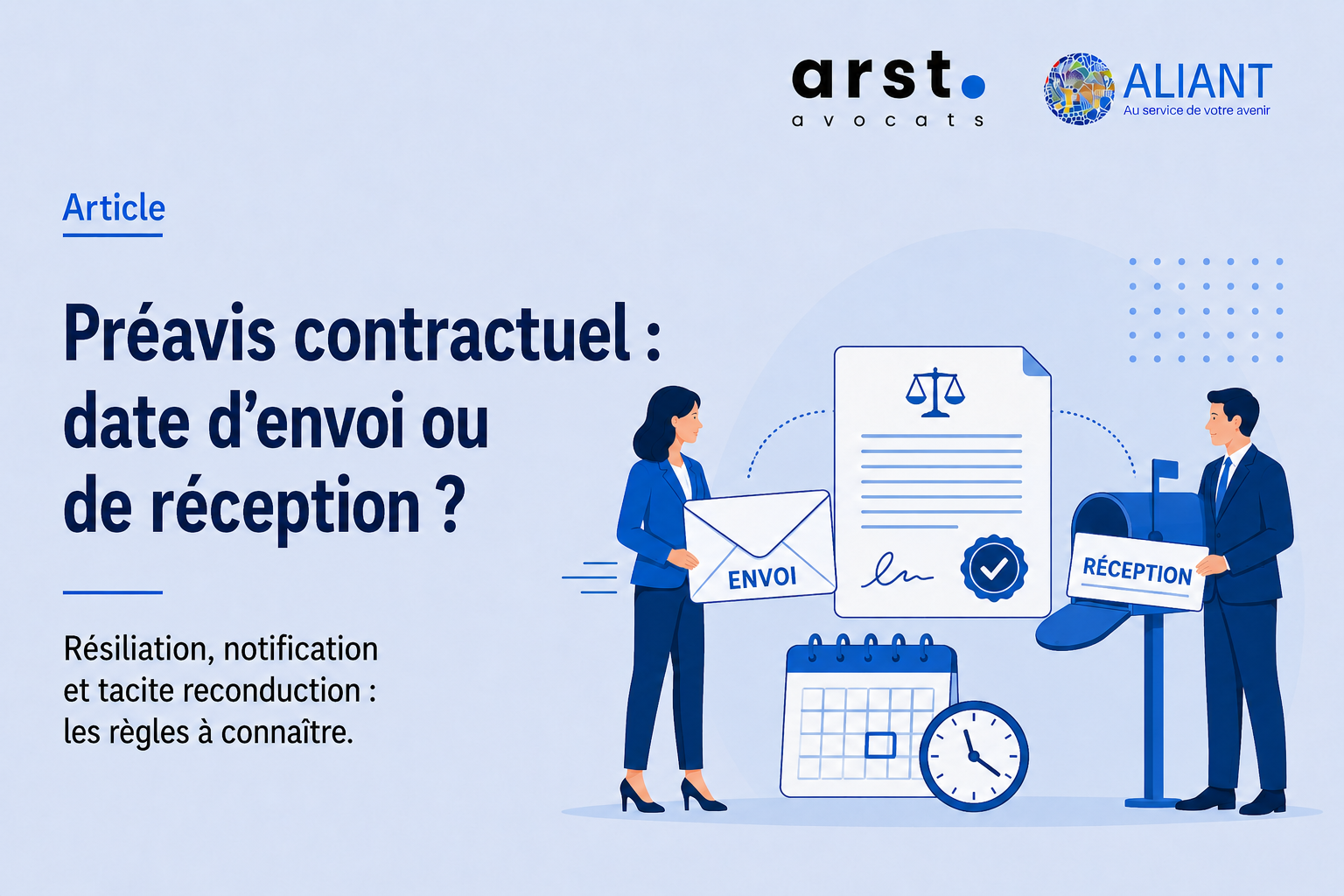
The contractual notice period is a crucial step when terminating or not renewing a commercial contract. To verify whether it has been respected, should the date of sending the notification or the date of its receipt by the other party be considered?
A difference of a few days can be enough to make a termination late, to cause the contract to be renewed for a new period or to engage the liability of the company that initiated the termination.
Contrary to popular belief, there is no single answer applicable to all contracts. The calculation of the notice period depends on the wording of the clause, the applicable legal framework, and the method of notification used.
Why is the start date of the contractual notice period crucial?
Let us take the example of a contract concluded for a period of one year, tacitly renewable, unless terminated with three months' notice before its expiry.
If the deadline is set for December 31st, must the notification:
- to be shipped no later than September 30th;
- having been presented to the recipient before that date;
- or to have actually been received by him before September 30th?
When the contract does not clearly answer this question, a few days of postal delivery may be enough to give rise to a dispute.
The company that thought it had terminated the contract may then find itself subject to automatic renewal. It may also be required to pay the installments corresponding to the new contractual period or to compensate for damages caused by an unlawful termination.
There is no general rule that always prioritizes sending or receiving
In commercial contracts, the first rule is to carefully examine the contractual stipulations.
Pursuant to Article1103 of the Civil Code, legally formed contracts have the force of law for those who entered into them. A clause may therefore expressly stipulate:
- the date the notification was sent;
- the date of first presentation of the mail;
- the date of actual delivery to the recipient;
- the date shown on the acknowledgement of receipt;
- or the date of sending an electronic registered letter.
When a clause is clear, it should, in principle, be applied. When it is imprecise or contradictory, its interpretation must be sought based on the common intention of the parties, in accordance with Articles 1188 et seq. of the Civil Code.
Prudence therefore forbids us from asserting that the postmark would always be valid or, conversely, that only actual receipt should be considered.
In some cases, receipt of the notification is expressly decisive
Some legal provisions link the effects of the termination to the receipt of the notification.
This is particularly the case with the unilateral termination of a contract for non-performance. According toArticle 1226 of the Civil Code, the creditor may terminate the contract by notification, after having, except in cases of urgency, formally demanded that the debtor fulfill their obligation within a reasonable timeframe. The termination then takes effect on the date the debtor receives the notification.
However, this scenario must be distinguished from ordinary termination or non-renewal of a contract upon its expiry. In the latter case, the relevant date will depend primarily on the contract's stipulations and any applicable special rules.
Receipt also plays a crucial role in certain specific legal regimes. For example, in residential leases, the Court of Cassation has ruled that the notice period begins upon receipt of the registered letter, service by a bailiff, or personal delivery. Therefore, an unclaimed registered letter may not trigger the expected notice period.
This solution, specific to a particular regime, cannot however be automatically transposed to all commercial contracts.
Other systems, on the contrary, use the date of dispatch
Certain special laws expressly stipulate that the time limit begins to run from the date of dispatch.
In matters of insurance, Article L. 113-12 of the Insurance Code provides, for cancellations falling within its scope, that the period runs from the date appearing on the postmark or the date of dispatch of the notification.
This example confirms that the question cannot be resolved without first identifying the nature of the contract and the texts that apply to it.
The contractual clause must therefore always be considered in light of any mandatory provisions governing the contract in question.
Vague contractual notice period: what are the risks for the company?
A clause stating only that "each party may terminate the contract subject to a notice period of three months notified by registered letter with acknowledgment of receipt" remains imperfect.
It specifies the time frame and medium for the notification, but does not clearly state whether compliance with the notice period is assessed:
- at the date of shipment;
- on the date of first presentation;
- or on the date of actual receipt.
The judge will then be able to seek the common intention of the parties, examine the general economics of the contract, the previous practices of the contracting parties or the customs of the sector concerned.
This uncertainty is all the more dangerous becauseArticle 1190 of the Civil Code provides that in case of doubt, a negotiated contract is interpreted against the creditor and in favor of the debtor, while a contract of adhesion is interpreted against the one who proposed it.
An imprecise drafting thus causes the parties to lose control of the contract's exit schedule.
The notification method must also be checked
Meeting the deadline is not enough. The notification method stipulated in the contract or by law must also be used.
A clause may impose:
- a registered letter with acknowledgment of receipt;
- an act of a judicial officer;
- a hand delivery against receipt;
- an electronic registered letter;
- a notification to the head office or to a contractually designated address;
- or several modes of transmission combined.
A simple email may not suffice when the contract requires a registered letter. Conversely, some clauses allow for electronic notification, provided that its sending and receipt can be verified.
An electronic registered letter can have the same legal value as its paper equivalent if the legal and regulatory requirements are met. In particular, it allows for the preservation of time-stamped proof of sending and receipt.
The content of the notification must also be checked. The intention to terminate the contract must be sufficiently clear and unambiguous. It is recommended to specify precisely:
- the contract in question;
- its date of signature and, where applicable, its amendments;
- the contractual or legal basis for the termination;
- the date on which the contract is due to end;
- the length of the notice period;
- the obligations remaining to be fulfilled during this period;
- and the operations to be organized upon termination of the relationship.
Respecting the contractual notice period therefore requires verifying both the applicable time limit, the imposed method of transmission and the legally relevant date.
The termination date does not exhaust the issue of reasonable notice
Even when a company respects the notice period stipulated in its contract, the termination can still be challenged on the grounds of the abrupt termination of an established business relationship.
ArticleL. 442-1, II of the Commercial Code establishes liability for anyone who abruptly terminates, even partially, an established business relationship without providing written notice that takes into account, in particular, the duration of the relationship.
The notice period stipulated in the contract does not necessarily constitute absolute protection. Depending on the length, intensity, and characteristics of the relationship, a longer period may be necessary.
Conversely, certain circumstances may allow for termination without notice, particularly in cases of sufficiently serious breach by the other party or force majeure. The seriousness of the breach must nevertheless be assessed carefully and be demonstrable.
Therefore, we must distinguish between two questions:
- Was the notification sent or received within the time frame stipulated in the contract?
- Was the length of the notice period given sufficient in view of the actual business relationship maintained?
A company may have correctly applied its termination clause while still being liable for an objectively insufficient notice period.
Automatic renewal: an error of a few days can extend the contract
The consequences of failing to respect the contractual notice period depend on the wording of the contract.
A clause may stipulate that the contract is automatically renewed:
- for a duration identical to the initial period;
- for a further period of one year;
- or for an indefinite period.
A late termination can therefore force the company to continue the relationship for several more months. It may also maintain certain exclusivity obligations, volume commitments, royalties, or services that have become unnecessary.
Before any notification, it is advisable to check not only the expiry date stated in the original contract, but also:
- amendments that may have modified its duration;
- any periods of suspension;
- the actual effective date of the contract;
- renewal clauses;
- the deadlines expressed in calendar days, working days or months;
- and any calculation rules that may be provided.
How to draft a secure contractual notice clause?
A clause regarding duration and termination should specify at a minimum:
- the initial duration of the contract;
- whether it is renewable or not;
- the duration of each renewal period;
- the notice period;
- the starting point and the end of this period;
- the date chosen to assess the validity of the notification;
- the accepted method(s) of notification;
- the physical and electronic addresses to use;
- the rules applicable when mail is not claimed;
- and the consequences of late notification.
A draft could, for example, include the following:
"The decision not to renew the contract must be notified to the other party at least three months before its expiry, by registered letter with acknowledgment of receipt. To assess compliance with this deadline, only the date of first presentation of the registered letter at the contractually designated address will be taken into consideration, regardless of the date on which the recipient actually becomes aware of it."
Another clause could, on the contrary, expressly specify the date of dispatch:
"The notice period will be deemed to have been respected if the notification has been sent, by registered letter with acknowledgment of receipt, before the expiry of the contractual period, the proof of posting serving as evidence."
The choice between these mechanisms must be adapted to the nature of the contract, the balance sought between the parties and any mandatory legal provisions.
Contractual notice period: checks to perform before any termination
To ensure compliance with the contractual notice period, the company should, before any notification of non-renewal or termination:
- reread the initial contract and all its amendments;
- identify the exact due date;
- determine whether the contract is for a fixed or indefinite term;
- check the length of the contractual notice period;
- to investigate the existence of a specific legal regime;
- control the notification method and address;
- calculate the delay while allowing a safety margin;
- to determine if the relationship can be classified as an established business relationship;
- keep proof of sending, presentation and receipt;
- anticipate the operational consequences of the end of the contract.
Whenever possible, it is best not to wait until the last day. Sending the notification several days or weeks before the deadline significantly reduces the risk of postal delays, incorrect addresses, or difficulties in providing proof.
ARST Avocats assists companies in managing their commercial contracts
The Contract and Distribution Law department of ARST Avocats is involved in drafting, negotiating, auditing and reviewing commercial contracts.
The firm can, in particular, assist companies with:
- secure their clauses regarding duration, tacit renewal and termination;
- audit a portfolio of contracts and establish a schedule of deadlines;
- assess the validity of a termination notice;
- determine the applicable notice period;
- prepare a letter of termination or non-renewal;
- analyze the risk of a sudden breakdown in an established business relationship;
- negotiate the terms of exiting the contract;
- or to defend the company in the event of litigation relating to the termination of the relationship.
The ARST Avocats teams also intervene in business litigation when the effective date of termination, the renewal of the contract or the sufficiency of the notice period is contested.
Are you considering terminating a contract or contesting its renewal?
Securing a contractual notice period is not limited to simply increasing the notice period stipulated in the contract.
A termination notice should not be prepared solely based on the notice period stipulated in the contract. The relevant date, the method of transmission, any applicable special rules, and the actual duration of the relationship must all be considered together.
The business law – commercial contracts department of the firm Arst Avocats is familiar with these issues.
If you are considering terminating or not renewing a commercial contract, or if your contracting party disputes the effective date of the termination, contact ARST Avocats. The firm can analyze your contractual documents, ensure the validity of the notification, and assess the legal and financial risks associated with ending the relationship.
Article written by Morgan Jamet

Morgan Jamet
Author
Partial activity – towards numerous checks!
Major checks announced by the Ministry of Labor. The announcement (published on the Ministry of Labor website) outlines a directive from the Ministry of Labor for the implementation of a major plan to monitor applications for partial unemployment benefits. The objectives...
Collective proceedings: the employee facing the procedure
Employer insolvency proceedings: what rights for employees? When a company is placed under safeguard proceedings, receivership, or liquidation, employees benefit from special protection. Their employment contracts are not...
Covid-19 & Contracts: Part 2 – IT Contracts
In this time of health crisis, which contractual clauses need to be amended? Arst Avocats has conducted an analysis of the main existing contracts, compiled an overview of the impact of Covid on current contracts, and drafted amendments for you...
COVID-19: Adapting the deadlines for convening and consulting the Works Council
Scope of application: Applies from May 3 to August 23, 2020. Does not apply to: Employer projects to address the economic, financial, and social consequences of the epidemic; Collective performance agreements; Job protection plans; ...
Covid-19 & Social Law: Towards the end of lockdown
On May 3, 2020, the Ministry of Labour published a national protocol for businesses to ease lockdown restrictions and ensure the health and safety of employees. This protocol is intended to serve as a guide for businesses to ensure the protection of employees during the...
In this time of health crisis, which contractual clauses need to be modified?
Arst Avocats has conducted an analysis of the main existing contracts, compiled an overview of the impact of Covid on current contracts, and developed the necessary standard amendments for you in the form of easily adaptable forms for each situation. Today...
Lease management in insolvency proceedings
The opening of the proceedings; the management of prior claims; what the landlord must declare: Claims corresponding to rent and related charges due and unpaid prior to the judgment opening the proceedings; according to what procedures? by the creditor or by...
Negotiated termination agreement & Timeframes: Clarifications welcome
An uncertainty resolved by the order of April 15, 2020, and the implementing decree of April 24, 2020. Law No. 2020-290 of March 23, 2020, concerning emergency measures to address the Covid-19 epidemic, notably established a state of health emergency and authorized the Government...
Covid-19 and Residence Permits: Frequently Asked Questions for Foreigners
CONSULATE: Are French consulates currently issuing visas? No, due to the Covid-19 health crisis, France has suspended the processing of applications and the issuance of visas until further notice (short-stay and long-stay visas). This...
Ordinance No. 2020-427 of April 15, 2020, containing various provisions regarding time limits to address the Covid-19 epidemic
The context of the establishment of Ordinance 2020-427 of April 15, 2020; Article 2 of Ordinance 2020-427; Article 4 of the Ordinance; The context of the establishment of Ordinance 2020-427 of April 15, 2020; Law No. 2020-290 of March 23, 2020, concerning emergency measures to...
Two-year statute of limitations in insurance: time limit and interruption
The two-year statute of limitations requires swift action against an insurer. Starting point, interruption, contract clauses, and scope of the February 9, 2023 ruling.
Interview with Romain Picard, young partner at the law firm Arst Avocats specializing in Corporate / M&A
Today we welcome Romain Picard, a young partner at the firm Arst Avocats, who explains the reasons that led him to join the firm and tells us about his plans for developing the Corporate/M&A practice within the firm...
Confidentiality of meetings between parties and lawyers: rules to know
The presence of lawyers does not automatically guarantee the confidentiality of a meeting. Professional secrecy, communications between lawyers, confidentiality agreements, and negotiation: the rules you need to know.