
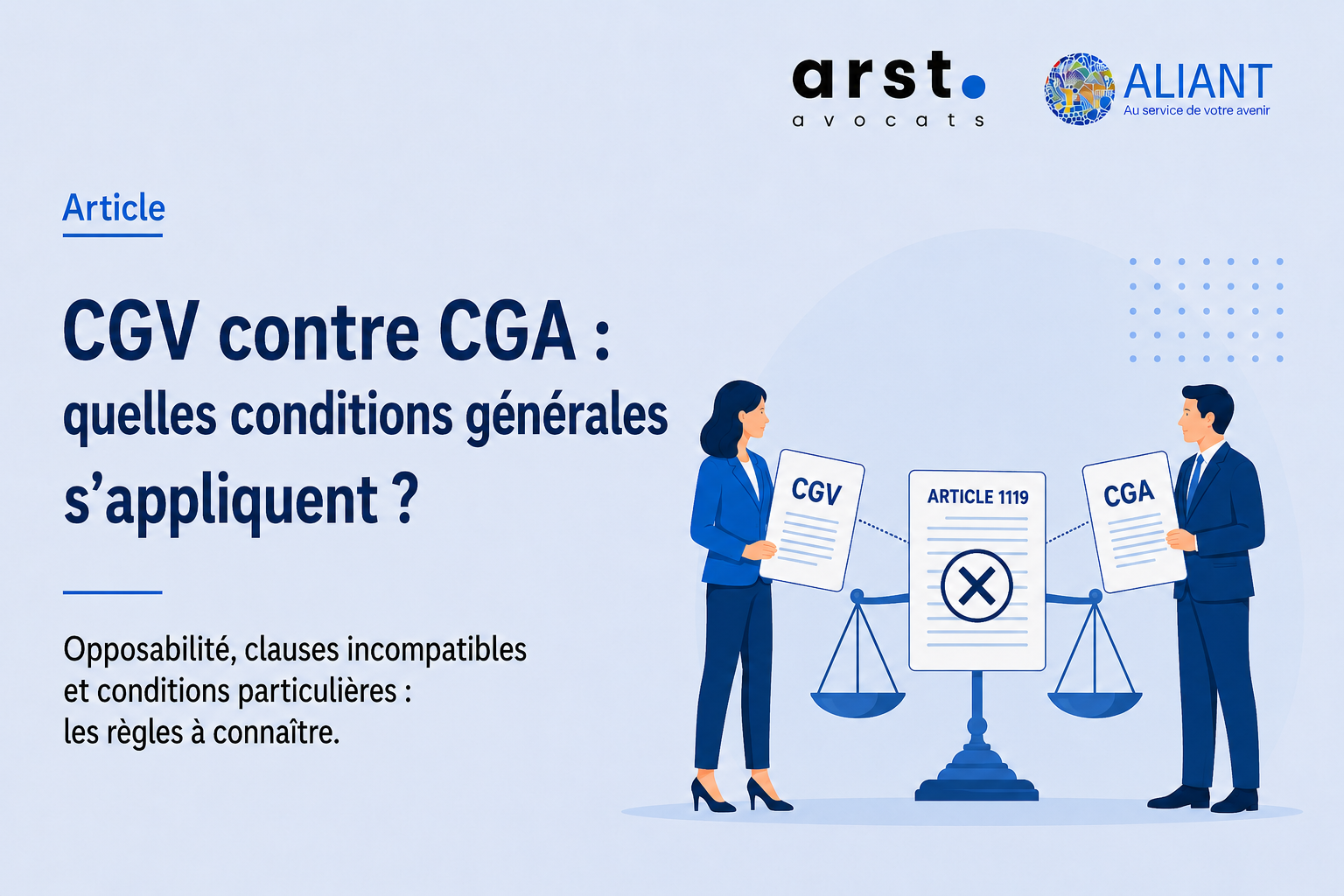
General Terms and Conditions of Sale versus General Terms and Conditions of Purchase: conflicts are frequent in business relationships. The supplier intends to apply its general terms and conditions of sale, while the buyer wants to impose its general terms and conditions of purchase. When these documents contain contradictory clauses, determining the applicable rules can become particularly difficult.
In business relationships between companies, each party often seeks to impose its own contractual rules.
The supplier provides its general terms and conditions of sale, while the buyer provides its general terms and conditions of purchase. The former limit the seller's liability, establish a retention of title clause, and designate the courts of Paris as the jurisdiction. The latter stipulate penalties, extend the supplier's warranties, and confer jurisdiction on the courts of the buyer's registered office.
The order is nevertheless accepted and executed without the parties having expressly resolved this contradiction.
Which general terms and conditions apply then? The supplier's terms and conditions of sale, the buyer's terms and conditions of purchase, or neither?
Contrary to popular belief, the battle over terms and conditions does not necessarily end with the victory of the first or last document submitted. French law establishes a more nuanced mechanism, the application of which depends on the content of the documents exchanged, their date of communication, and, above all, proof of their acceptance.
First step: check if the general terms and conditions are enforceable
Before investigating which clauses should prevail, it is necessary to determine whether the general conditions invoked have actually entered into the contractual scope.
Article1119 of the Civil Code establishes an essential rule:
"General terms and conditions invoked by one party are only effective with respect to the other party if they have been brought to the latter's attention and accepted."
Two conditions must therefore be met:
- The contracting party must have had the opportunity to review the general terms and conditions before entering into the agreement;
- He must have accepted them, either expressly or, in certain circumstances, tacitly.
The mere existence of general terms and conditions (GTC) or general terms and conditions of purchase (GTP) is not enough to make them enforceable. A company must be able to demonstrate when and how they were communicated and accepted.
How to establish communication and acceptance?
The signing of a contract, quote or purchase order containing a clear reference to the general terms and conditions constitutes an important piece of evidence.
The statement may, for example, indicate that the signatory acknowledges having received, read and accepted the general terms and conditions attached to the document.
In an electronic contract process, an acceptance checkbox can also establish consent, provided that:
- the general terms and conditions must be effectively accessible before validation;
- the accepted version can be identified;
- the date and author of the acceptance are to be retained;
- the document can be downloaded or stored on a durable medium.
Conversely, a simple reference to terms and conditions available "on request", a barely visible link or an illegible document may not be sufficient.
Are the terms and conditions appearing on an invoice legally binding?
The invoice is usually issued after the contract has been concluded. Therefore, it is not always the appropriate medium for introducing new contractual terms.
The Court of Cassation thus approved a Court of Appeal decision that dismissed general terms and conditions which were not mentioned in the contract, appeared on the back of the invoices in tiny print and had not been accepted either expressly or tacitly, despite the existence of ongoing business relations (Cass. com., March 16, 2022, No. 20-22.269).
The usual presence of general terms and conditions on the back of invoices can nevertheless be an indicator in certain long-standing and recurring business relationships. However, it does not relieve the company invoking them of the burden of proving that its partner was aware of and accepted them.
CGV vs. CGA: there is no automatic victory
In business-to-business relationships, the supplier generally invokes its general terms and conditions of sale, while the buyer intends to enforce its general terms and conditions of purchase.
Each document frequently contains a clause stating that it prevails over the other party's terms and conditions:
- The general terms and conditions state that they prevail over all purchase conditions;
- The general terms and conditions specify that they exclude the application of the supplier's terms of sale.
These unilateral declarations are not sufficient to resolve the difficulty when both parties have provided for symmetrical stipulations.
The first document sent does not necessarily win
The fact that the general terms and conditions were communicated first can be an indicator in the analysis of contract formation. However, it does not guarantee their application.
An offer that explicitly refers to general terms and conditions (GTC), followed by an order placed without reservation, may be interpreted as acceptance of those GTC. The outcome will be different if the buyer responds by sending a purchase order expressly stating that only their own general terms and conditions (GTC) apply.
The last document submitted does not win the battle either
French law also does not establish a general rule according to which the last general terms and conditions transmitted before the execution of the contract would prevail.
The chronology of exchanges is only one element of analysis among others. The following must also be examined:
- the nature of the initial offer;
- the document by which the order was accepted;
- the cross-references made between the different documents;
- any reservations that may be expressed;
- the signature of the parties;
- their behavior during the execution of the contract;
- practices established during previous business relationships.
The objective remains to determine what the parties have truly agreed to.
General Terms and Conditions of Sale versus General Terms and Conditions of Purchase: which clauses are neutralized?
Article 1119 of the Civil Code then provides:
"In the event of a discrepancy between the general terms and conditions invoked by each party, the incompatible clauses shall be null and void."
French law thus retains a neutralization mechanism sometimes referred to as the "knock-out rule".
When a clause in the General Terms and Conditions of Sale directly contradicts a clause in the General Terms and Conditions of Purchase, neither stipulation necessarily prevails. They can be mutually neutralized.
The contract remains applicable, but the issue in question is resolved by:
- any special conditions agreed upon by the parties;
- the supplementary provisions of the law;
- where applicable, the applicable professional practices.
The neutralization does not necessarily apply to all general terms and conditions
Comparing the general terms and conditions of sale and the general terms and conditions of purchase does not automatically lead to rejecting both documents in their entirety.
Compatible clauses may continue to have effect. Only truly irreconcilable stipulations are, in principle, neutralized.
For example, if the general terms and conditions of sale and the general terms and conditions of purchase contain identical provisions on confidentiality, but contradictory clauses on the competent jurisdiction, the contradiction may be limited to the latter.
Neutralization is not a purely mechanical operation
Before setting aside a clause, the judge must determine:
- if each of the general conditions has been brought to the attention of the other party and accepted;
- if the clauses invoked are truly incompatible;
- if another contractual document resolves the contradiction;
- what was the common intention of the parties;
- whether the neutralization only affects certain clauses or more broadly calls into question the application of the general conditions.
When contradictions are numerous or relate to structural elements of the relationship, the analysis may lead to discarding a broader set of stipulations and returning to common law.
The "knock-out rule" is therefore not a magic bullet that automatically designates the applicable clauses. Its application requires a complete analysis of the entire contract.
Example: two contradictory jurisdiction clauses
A supplier's general terms and conditions may assign jurisdiction to the courts of Paris, while its client's general terms and conditions may designate those of Lyon.
If both clauses have entered into the contractual scope, but neither party has accepted the stipulation of the other, they may be regarded as incompatible and be without effect.
The competent jurisdiction will then be determined according to the ordinary rules of procedure.
However, this neutralization should not be considered automatic. If a framework agreement signed by both parties expressly designates the courts of Paris, this specific condition may prevail over any conflicting provisions in the general terms and conditions of sale or purchase.
Furthermore, between traders, Article 48 of the Code of Civil Procedure requires that the clause derogating from territorial jurisdiction be specified in a very conspicuous manner in the commitment of the party against whom it is invoked.
Its discreet insertion into illegible general terms and conditions does not necessarily make it effective.
The specific conditions take precedence over the general conditions
Article 1119 of the Civil Code establishes a third rule:
"In the event of any discrepancy between general terms and conditions and specific terms and conditions, the latter shall prevail."
The provisions specifically negotiated between the parties therefore prevail over standardized clauses.
The following may constitute special conditions:
- a signed framework agreement;
- a trade agreement;
- an accepted quote;
- a countersigned purchase order;
- a specially negotiated annex;
- an amendment;
- an exchange of emails establishing unambiguously an agreement on a specific clause.
A specific condition providing for a payment period of 45 days will therefore, in principle, prevail over general conditions providing for payment in 30 days.
However, these documents only play this role if they have themselves been accepted by the parties.
Does the execution of the contract constitute acceptance of the general terms and conditions?
The execution of an order may, in certain circumstances, constitute tacit acceptance. However, it would be dangerous to make this an automatic rule.
The judge examines the specific behavior of the parties:
- Were the general terms and conditions included with the offer, quote, or order form?
- Did the main document clearly refer to it?
- Were the same conditions regularly communicated during previous relationships?
- Had the other party to the contract expressed any reservations?
- Had he executed several contracts without dispute?
- Had the parties already applied certain clauses in previous transactions?
A consistent flow of business can help demonstrate awareness and acceptance of regularly communicated general terms and conditions. However, contract performance does not necessarily determine which of the conflicting general terms and conditions of sale or purchase has been accepted.
Thus, the silence of a company does not, in itself, constitute acceptance of all the clauses contained in the documents sent by its partner.
The general terms and conditions form the basis of the negotiation, but are not necessarily the final contract
Article L. 441-1 of the Commercial Code presents the general terms and conditions of sale as the "sole basis for commercial negotiation".
This rule gives general terms and conditions (GTC) an essential role in building the relationship between a supplier and a professional buyer. They constitute the starting point for negotiation and contribute to the transparency of the commercial relationship.
However, this does not mean that the General Terms and Conditions apply automatically and in full to every order, nor that they necessarily prevail over the buyer's General Terms and Conditions of Purchase.
We need to distinguish between two questions:
- The Commercial Code organizes the communication of the general terms and conditions and their role in commercial negotiation;
- The Civil Code determines whether the general conditions have been accepted and how to resolve any potential contradictions.
The assertion that the general terms and conditions constitute the "sole basis" of the negotiation therefore does not exempt the supplier from demonstrating their acceptance.
The parties may also negotiate specific terms of sale. These will specify any exceptions agreed upon with a particular customer and will, on these points, prevail over the general terms and conditions.
An enforceable clause is not necessarily valid or fully effective
The first question is to determine whether a clause has entered into the contractual framework. However, acceptance of the clause does not necessarily end all discussion.
A clause that is known and accepted can still be subject to various checks.
Clauses limiting or excluding liability
A clause limiting the supplier's liability must first have been brought to the buyer's attention and accepted by the buyer.
It can then be reviewed in light of other rules, particularly when it deprives the debtor's essential obligation of its substance or when it contributes to a significant imbalance between the rights and obligations of the parties.
Therefore, a distinction must be made:
- the enforceability of the clause;
- his interpretation;
- its validity;
- its effectiveness in relation to the fault committed and the obligation concerned.
The mere presence of a compensation cap in accepted terms and conditions does not guarantee that it will be applied in all circumstances.
Penalty clauses
The general terms and conditions of sale and the general terms and conditions of purchase may provide for different penalties for the same breach.
If these stipulations are incompatible, they can be neutralized. If a penalty clause remains applicable, the judge also retains the power to reduce or increase its amount when it appears manifestly excessive or derisory, in accordance with Article 1231-5 of the Civil Code.
Jurisdiction clauses
In addition to their acceptance, jurisdiction clauses must comply with the specific requirements of procedural law.
Between businesses, these clauses must be clearly specified in the agreement of the party against whom they are invoked. A clause buried in difficult-to-read general terms and conditions is therefore legally vulnerable.
The significant imbalance
In certain business relationships, a clause imposed by one of the partners may also be discussed on the basis of Article L. 442-1 of the Commercial Code when it creates a significant imbalance in the rights and obligations of the parties.
Formal acceptance of the general terms and conditions is therefore not always sufficient to protect their content from all control.
How to prevent conflicts between general terms and conditions of sale and general terms and conditions of purchase?
The best protection does not consist solely of inserting a clause into one's own terms and conditions stating that they will prevail over all other documents.
The entire contractual process needs to be organized.
1. Communicate the general terms and conditions before the conclusion of the contract
The general terms and conditions should accompany, as far as possible:
- the offer;
- the business proposal;
- the quote;
- the order form;
- Order acknowledgement.
The company must be able to prove the exact version communicated at the time the contract was concluded. Sending a dated PDF document offers greater security in this regard than a simple link to a web page that may be modified.
2. Obtain identifiable acceptance
The main document may include a statement by which the contracting party acknowledges having received and accepted the attached general terms and conditions.
In an electronic process, it is important to retain proof:
- of the version presented;
- of its accessibility;
- from the date of acceptance;
- of the identity of the person who performed the validation.
3. Establish a contractual hierarchy
The contract must specify the order of priority of the documents, for example:
- the amendments;
- the specific conditions or the framework agreement;
- the technical and commercial appendices;
- the general terms and conditions expressly accepted;
- purchase orders.
This hierarchy must itself result from an agreement between both parties. A precedence clause appearing only in the general terms and conditions of sale or in the general terms and conditions of purchase risks conflicting with the symmetrical clause of the other party.
4. Identify the clauses that are truly conflicting
It is not always necessary to negotiate every provision of the partner's general terms and conditions.
The analysis should focus primarily on the clauses presenting the greatest risks:
- liability and compensation limits;
- guarantees;
- price and price revision;
- deadlines and penalties;
- reception conditions;
- intellectual property;
- confidentiality ;
- personal data;
- retention of title;
- duration and termination;
- Applicable law and competent jurisdiction.
A table of exceptions or a contractual annex limited to these points often makes it possible to effectively secure the relationship.
5. Express reservations
When a company receives the terms and conditions from its partner and does not intend to accept them, it should avoid systematically remaining silent.
She may indicate the following in her order acknowledgement or confirmation:
- that it rejects certain identified clauses;
- that she accepts the order subject to the signing of a specific contract;
- that the documents must be submitted to the legal department;
- that no deviation from its own conditions will be permitted without written agreement.
This reservation does not in itself guarantee the prevalence of its own general conditions, but it prevents its behavior from subsequently being interpreted as an unconditional acceptance.
6. Train the sales teams and purchasing departments
The mastery of general terms and conditions should not remain confined to the legal department.
A salesperson who accepts a purchase order without examining the attached general terms and conditions, or a buyer who validates an offer referring to the supplier's general terms and conditions, can contribute to creating an ambiguous contractual situation.
Operational teams need to know:
- what documents they can accept;
- which clauses require legal validation;
- how to formulate a reservation;
- when to suspend the order process to request arbitration.
7. Retain contractual evidence
The company must be able to reconstruct the contractual history several years after the operation.
In particular, it is important to retain:
- commercial proposals;
- quotes and purchase orders;
- the general terms and conditions in their dated version;
- negotiation emails;
- acknowledgments of receipt;
- electronic signatures;
- the amendments;
- the reservations expressed;
- documents relating to the execution of the contract.
And what about in the presence of an international contract?
The solution presented mainly concerns contracts subject to French law.
In the case of a foreign supplier, a buyer established outside of France, or an international delivery, other rules may apply:
- determination of the applicable law;
- Vienna Convention on the International Sale of Goods;
- European or international rules of jurisdictional competence;
- specific requirements regarding the acceptance of jurisdiction clauses;
- possible application of foreign law.
The dispute over general terms and conditions must then be examined in light of applicable law and the rules of private international law. The solutions provided solely by Article 1119 of the Civil Code cannot be automatically transposed.
The battle over terms and conditions is won before the dispute
General terms and conditions are not simply an administrative document attached to invoices or orders. They govern the allocation of risks and often become crucial when a delay, non-payment, non-conformity, or breakdown of the business relationship occurs.
In the event of a conflict between general terms and conditions of sale and general terms and conditions of purchase, there is not necessarily a "winning" document. The judge may consider that certain conditions were never accepted, invalidate the incompatible clauses, or give precedence to the specific conditions negotiated by the parties.
An effective contractual policy therefore requires the following elements to be considered:
- the drafting of documents;
- their order of priority;
- the ordering process;
- digital tools;
- the powers of operational teams;
- the preservation of evidence.
ARST Avocats' business law and commercial contracts department assists companies in drafting, auditing and negotiating their general terms and conditions of sale, their general terms and conditions of purchase and their commercial contracts.
The firm also intervenes to analyze the enforceability of various contractual documents, secure ordering processes, and defend the company's interests when a dispute reveals a contradiction between the parties' general terms and conditions. Contact us.
Article written by Morgan Jamet, partner at the law firm Arst Avocats

Morgan Jamet
Author
Should a lawyer draft a formal notice?
A formal notice can trigger the accrual of interest, pave the way for the termination of a contract, or constitute a decisive piece of evidence in court. When should it be entrusted to a lawyer?
Family SCI or joint ownership: which structure to choose for a family property purchase?
By Olivier Paquerau, of counsel at ARST Avocats. Buying a home, a rental property, or a family residence with several people quickly leads to a fundamental question: should you buy jointly or form a real estate company?...
Psychosocial risks in the workplace: what are the employer's obligations?
By Chaouki Gaddada, partner lawyer in charge of employment law at ARST Avocats. Chronic stress, work overload, isolation, internal conflicts, loss of meaning, or reports of harassment: psychosocial risks can weaken employees...
Should a lawyer draft a formal notice?
A formal notice can trigger the accrual of interest, pave the way for the termination of a contract, or constitute a decisive piece of evidence in court. When should it be entrusted to a lawyer?
Family SCI or joint ownership: which structure to choose for a family property purchase?
By Olivier Paquerau, of counsel at ARST Avocats. Buying a home, a rental property, or a family residence with several people quickly leads to a fundamental question: should you buy jointly or form a real estate company?...
Acquiring 10% of a French company listed in London can now trigger an audit by the French Ministry of Economy and Finance (Bercy)
Since August 17, 2026, crossing the 10% threshold of voting rights of a French company listed on certain foreign markets may fall under the control of foreign investments in France.