
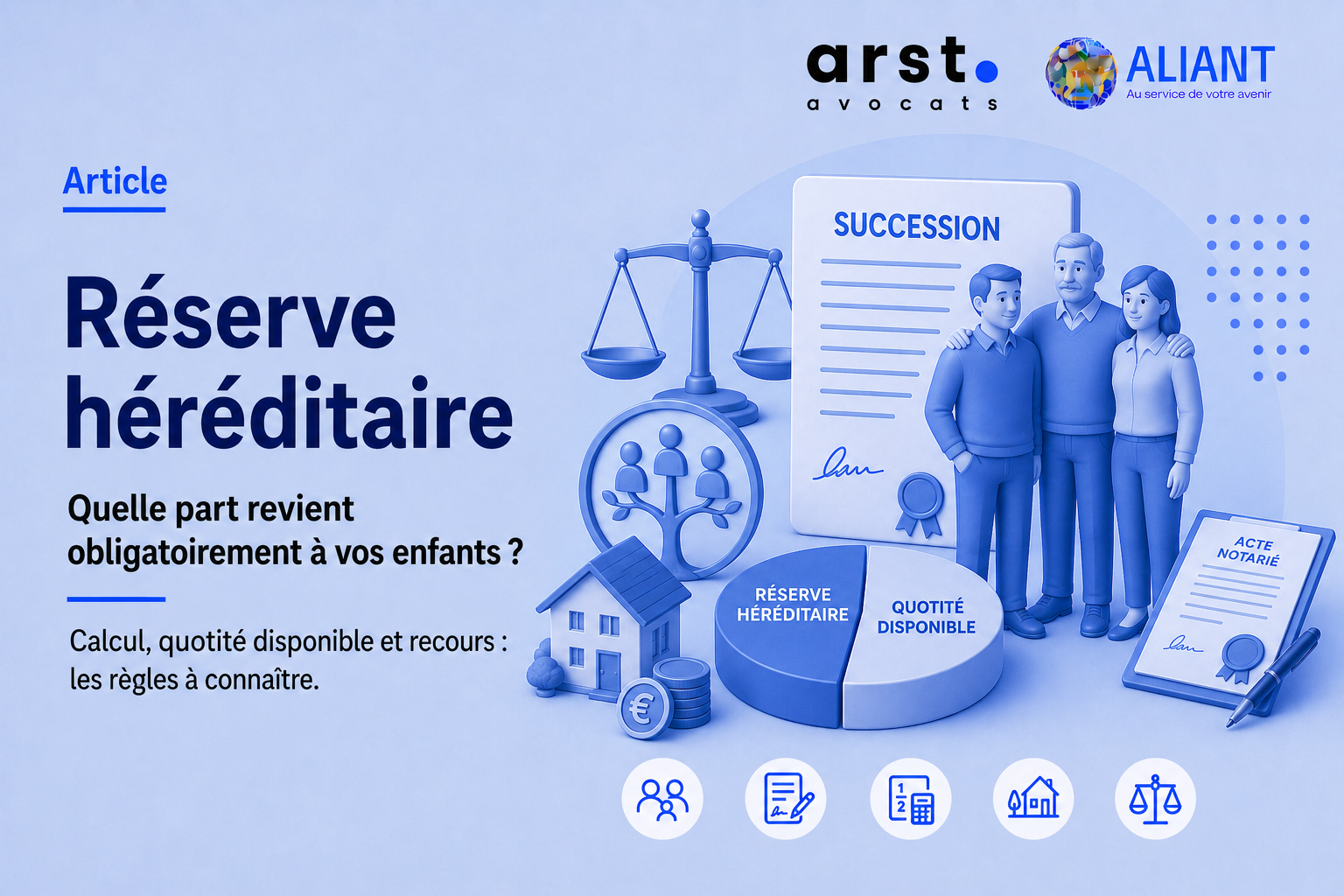
The reserved portion is the share of the estate that must go to the deceased's children. French law generally prohibits disinheriting them. The remaining portion, called the disposable portion, can be freely bequeathed. Here's how to calculate the reserved portion and what legal recourse is available if it is not respected.
Key point: Articles 912 and 913 of the Civil Code establish the minimum inheritance rights for the deceased's children. One child receives half of the estate, two children two-thirds, and three or more children three-quarters. The remaining portion constitutes the disposable portion.
Table of the reserved portion of the estate according to the number of children
Article 913 of the Civil Code sets the amount of the reserved portion according to the number of children, without distinction between them.
With one child: reserve of 1/2, disposable portion of 1/2.
With two children: reserve of 2/3, i.e. 1/3 each, disposable portion of 1/3.
Inheritance reserve for 3 children: reserve of 3/4, i.e. 1/4 each, disposable portion of 1/4.
With four or more children: reserve of 3/4 shared equally, disposable portion of 1/4.
The reserved portion no longer varies beyond three children. It is capped at three-quarters of the total estate, regardless of the number of heirs.
Calculating the reserved portion of an estate, step by step
The calculation of the reserved portion of the estate does not only concern the assets present on the day of death. It is determined on a reconstituted estate, in three stages.
First step: we add up the assets existing on the day of death, after deducting debts.
The second step involves notionally reintegrating all gifts made by the deceased during their lifetime, even those from long ago. This is the point most heirs are unaware of: a gift made twenty years earlier is taken into account in the calculation.
Third step: we apply the reserve fraction corresponding to the number of children.
Example with two children. Net estate at death: €300,000. Total reserve of 2/3, or €200,000, of which a minimum of €100,000 is allocated to each child. Disposable portion of 1/3, or €100,000, which the deceased could freely dispose of.
Example with three children. Same assets of €300,000. Total reserve of 3/4, or €225,000, divided into €75,000 per child. Reduced disposable portion of €75,000.
Example with a prior gift. Two children, €300,000 in assets at the time of death, but a gift of €200,000 made ten years earlier to one of them. The estate for calculation becomes €500,000. The total reserved portion increases to €333,333, or €166,666 per child. The child who did not receive a gift can then claim the difference.
The surviving spouse's reserved portion of the estate
In the presence of children, the surviving spouse is not a forced heir. He has distinct legal rights: Article757 of the Civil Code gives him the choice between the usufruct of all existing assets and ownership of one-quarter, in the presence of children of the marriage.
However, in the absence of descendants, the surviving spouse's reserved portion does indeed exist: Article 914-1 of the Civil Code reserves one-quarter of the estate for them. The disposable portion then falls to three-quarters. Other relatives, ascendants, and collaterals are never entitled to a reserved portion.
The deceased can favor their spouse beyond their legal rights by using the ordinary disposable portion or the special disposable portion between spouses, in full ownership, usufruct, or a combination of both. The deceased's children always retain their reserved portion in value, possibly received as bare ownership.
Blended families: the entrenched action
This is the situation that generates the most disputes. When the matrimonial property regime is a universal community of property with full ownership passing to the surviving spouse, the estate can be virtually empty upon the death of the first spouse. If there are children together, this arrangement is not considered fraudulent.
However, if the deceased leaves children from a previous marriage, Article1527 of the Civil Code provides for a reduction action. This allows the surviving spouse to be limited to the disposable portion of the estate, in order to reconstitute the reserved portion for children from previous marriages.
Children from another union are counted exactly the same as others for the calculation of the reserved portion. No difference in treatment is permitted.
Life insurance, preferential share, donation: the blind spots of the reserve
Three mechanisms are in principle exempt from the hereditary reserve, and it is through them that most imbalances occur.
Life insurance. The capital paid to the designated beneficiary is outside the estate and is not included in the calculation. There is, however, a limit: when premiums are clearly excessive in relation to the policyholder's means, they may be reclaimed. The assessment depends on the policyholder's age, assets, and the usefulness of the contract.
The survivorship clause. This allows the surviving spouse to take an asset before any division of the estate. It is a matrimonial benefit, not a gift: therefore, it is not included in the calculation of the reserved portion, except in the case of a claim for reduction in the presence of children from a previous relationship.
The gift to the surviving spouse. It expands the rights of the surviving spouse within the limits of the special spousal share. It cannot infringe upon the children's reserved portion.
What to do if the reserve is damaged
When a gift or bequest exceeds the disposable portion, it infringes upon the reserved portion. Article 921 of the Civil Code then provides for an action for reduction.
It is reserved for forced heirs and their successors in title. Its aim is to restore the reserved portion of the estate, most often through the payment of a reduction indemnity rather than the return of the asset itself. The time limit is five years from the opening of the succession, or two years from the discovery of the infringement, but never exceeding ten years after the death.
An heir can also waive this right in advance, by means of a specific notarial act signed during the donor's lifetime.
The order of heirs when there is no will
In the absence of provisions, the succession follows the legal order of inheritance. Four orders follow one another, and the heirs of one order exclude those of the following orders.
First order: descendants, children then grandchildren. Second order: father and mother, as well as brothers, sisters and their descendants. Third order: grandparents and great-grandparents. Fourth order: uncles, aunts and cousins, up to the sixth degree.
Within the same order of succession, the closest relative takes precedence over the more distant, subject to the principle of representation which allows grandchildren to inherit in place of their predeceased parent. The surviving spouse has a parallel entitlement, significantly strengthened by the law of December 3, 2001.
In the absence of descendants and a spouse, there are no forced heirs: the deceased had free disposal of the entire estate.
Frequently asked questions about forced heirship
Can a child be disinherited? No, not under French law. A child excluded by a will can claim their reserved share through an action for reduction. Only unworthiness to inherit, declared by a judge in serious cases, deprives an heir of their rights.
What is the amount of the reserved portion when there is only one child? Half of the entire estate, after deducting any prior gifts. The other half constitutes the disposable portion.
Does life insurance fall under the forced heirship rules? In principle, no. It is only included if the premiums paid are clearly excessive in relation to the deceased's assets and age.
Are grandchildren entitled to a reserved portion of the estate? Only by representation, when their own parent has predeceased them or has renounced their inheritance. They then take their place and share.
What happens if a gift exceeds the disposable portion? The reserved portion is infringed upon. The heirs entitled to a reserved portion can claim compensation from the donee, calculated on the value of the property on the day of the division.
How long do we have to act? Five years from the date of death, or two years from the day the condition was discovered, up to a maximum of ten years after death.
Assert your rights with a lawyer
The calculation of the reserved portion of an estate is rarely contested in principle, almost always on the figures: which gifts must be included, at what value, and according to which matrimonial property regime. Reconstitution of the estate, valuation of assets, legal action for reduction or abatement: each step requires careful documentation. The ARST firm assists heirs in analyzing their rights and, if necessary, in the legal proceedings.
If you are facing a problem determining the reserved portion of an estate or an infringement thereof, please contact us.
Article written by Olivier Paquereau

Olivier Paquereau
Author
Should a lawyer draft a formal notice?
A formal notice can trigger the accrual of interest, pave the way for the termination of a contract, or constitute a decisive piece of evidence in court. When should it be entrusted to a lawyer?
Family SCI or joint ownership: which structure to choose for a family property purchase?
By Olivier Paquerau, of counsel at ARST Avocats. Buying a home, a rental property, or a family residence with several people quickly leads to a fundamental question: should you buy jointly or form a real estate company?...
Psychosocial risks in the workplace: what are the employer's obligations?
By Chaouki Gaddada, partner lawyer in charge of employment law at ARST Avocats. Chronic stress, work overload, isolation, internal conflicts, loss of meaning, or reports of harassment: psychosocial risks can weaken employees...
Should a lawyer draft a formal notice?
A formal notice can trigger the accrual of interest, pave the way for the termination of a contract, or constitute a decisive piece of evidence in court. When should it be entrusted to a lawyer?
Family SCI or joint ownership: which structure to choose for a family property purchase?
By Olivier Paquerau, of counsel at ARST Avocats. Buying a home, a rental property, or a family residence with several people quickly leads to a fundamental question: should you buy jointly or form a real estate company?...
Acquiring 10% of a French company listed in London can now trigger an audit by the French Ministry of Economy and Finance (Bercy)
Since August 17, 2026, crossing the 10% threshold of voting rights of a French company listed on certain foreign markets may fall under the control of foreign investments in France.